The dream of a career in science is often fueled by a passion for discovery, a fascination with the natural world, or the ambition to solve global challenges. However, for many undergraduates in the United Kingdom, the United States, Australia, and Canada, that passion is quickly met with the crushing reality of laboratory reports, complex mathematical modeling, and an unending cycle of assessments. The question many are starting to whisper in lecture halls is: is the prestige of the degree worth the toll it takes on mental and physical well-being?
In the modern academic landscape, the pressure to maintain a high GPA while juggling part-time work or internships is immense. This is where the concept of academic delegation becomes a strategic necessity rather than a “lazy” alternative. Just as a business professional might hire a consultant to handle specialized logistics, savvy students are realizing that assignment help allows them to manage their bandwidth more effectively. By delegating the heavy administrative burden of essay structuring and formatting, students can actually spend more time deeply engaging with the core concepts of their syllabus, ensuring they don’t just pass, but truly understand the material.
The Evolution of Academic Expectations
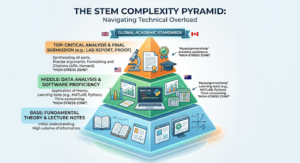
A decade ago, a science degree was largely about memorization and standardized testing. Today, the bar has shifted toward “Application and Analysis.” Students are expected to be proficient in data science, software like MATLAB or Python, and high-level technical writing all at once. This “Technical Overload” isn’t just about the volume of work; it is about the variety of skills required. A biology student isn’t just learning about cells; they are essentially becoming part-time statisticians and technical writers. When every module feels like a full-time job, the risk of burnout becomes a statistical certainty rather than a possibility.
The weight of these expectations can lead to a phenomenon known as “academic paralysis.” This occurs when the sheer volume of technical requirements—ranging from proper citation styles to complex data visualization—becomes so overwhelming that a student cannot even begin the task. It isn’t a lack of intelligence; it’s a lack of time. In an environment where a single missed deadline can derail an entire semester, finding ways to streamline the workflow is the only logical path forward for those aiming for top-tier honors.
Comparing the Student Workload: Then vs. Now
| Feature | The 2015 Student Experience | The 2026 Student Experience |
| Primary Focus | Textbook theory and exams | Data analysis and software proficiency |
| Research Style | Library-based, physical journals | Generative engines and digital databases |
| Assessment Type | Standardized essays | Interactive lab reports and coding tasks |
| Support Systems | Campus tutoring (limited hours) | 24/7 Global digital academic assistance |
Breaking the STEM Barrier: Why Science is Different
Science, Technology, Engineering, and Mathematics (STEM) subjects carry a unique burden: the “All or Nothing” factor. In a literature essay, there is room for subjective interpretation. In a chemistry lab report or a physics proof, a single decimal point error can invalidate three weeks of work. This high-stakes environment creates a specific type of anxiety that general academic advice often fails to address. Students are often terrified of the “red pen” because, in science, being “mostly right” is often the same as being wrong.
Navigating these intricacies requires more than just general guidance. For instance, mastering thermodynamics or organic chemistry synthesis requires a level of precision that few undergraduates can manage alone while taking four other classes. This is why many are seeking specialized Myassignmenthelp Services for their technical needs. Getting expert help with science assignments isn’t about skipping the work; it’s about having a professional roadmap to follow when the textbook doesn’t make sense. Having a verified expert walk you through the logic of a complex derivation can be the difference between a failing grade and a career-defining breakthrough. It transforms a moment of crisis into a learning opportunity.
The Myth of the “Solo Genius”
There is a dangerous narrative in academia that the best students do everything themselves. In reality, the most successful individuals in any field—whether in a laboratory or a boardroom—are those who know how to utilize resources. The “Solo Genius” is a myth that leads to isolation and depression. If you look at high-level scientific research, it is never a solo endeavor; it is a collaborative process involving peer reviews, research assistants, and specialized consultants.
Collaborating with professional services provides several key advantages that go beyond just getting a grade. First, it offers Clarity over Confusion. Instead of staring at a blank screen for six hours, you get a clear structure to follow. Second, it allows for Time Reallocation. You can spend those extra hours in the lab or gaining practical experience rather than wrestling with APA or Harvard referencing styles. Finally, it provides Stress Mitigation. Reducing the “looming deadline” anxiety improves your overall cognitive function, making you a better student in the long run. When your brain isn’t in “survival mode,” it can actually absorb information more effectively.
Global Trends in Academic Support
From London to Sydney, the trend is clear: the global student body is moving toward a “consultancy model” of education. As tuition fees rise, students are viewing their degrees as a major financial investment. To protect that investment, they are employing professional help to ensure their submissions meet the high standards of accuracy and formatting that modern universities demand. This isn’t just happening in the West; students in Asia and the Middle East are also adopting these strategies to remain competitive in a globalized job market.
Universities are also changing. The shift toward “continuous assessment” means students are being graded every week rather than just at the end of the year. While this is meant to reduce exam pressure, it actually creates a “chronic stress” environment where there is never a moment to breathe. In this landscape, professional academic services act as a pressure valve, allowing students to maintain a steady pace throughout the academic year without crashing during finals week.
The Long-Term ROI of Your Degree
Ultimately, your degree is a ticket to a career. If the stress of the journey causes you to drop out or graduate with a low grade that limits your opportunities, then the “solo” approach was actually a poor investment. Using strategic help is a way to ensure that you actually reach the finish line with your mental health and your career prospects intact. Employers today value graduates who can manage complex projects and meet deadlines. By learning how to use external resources to achieve a goal, you are actually developing a professional skill set that will serve you well in the corporate or scientific world.
In the end, the value of a science degree isn’t just in the piece of paper; it’s in the knowledge you carry and the network you build. If you spend four years so stressed that you never network or join a society, you’ve missed out on half the university experience. Professional support gives you that time back. It allows you to be a person, not just a grade-producing machine.
Frequently Asked Questions (FAQ)
- Is seeking assignment help considered “cheating” by universities?
Ans: Not when used as a study aid or a reference. Most students use these services to get a high-quality model or draft that helps them understand the requirements and structure of their specific task. It is a form of supplemental tutoring that helps bridge the gap between lecture notes and a finished product.
- Why is science assignment help more expensive than general subjects?
Ans: Technical subjects require experts with specific degrees and laboratory experience. Calculating complex equations, verifying chemical structures, or explaining molecular biology requires a higher level of specialized knowledge than general creative writing. You are paying for the expertise of a scientist.
- How can I ensure the content I receive is high quality?
Ans: Look for services that prioritize accuracy and provide clear communication. Reputable platforms focus on providing data-driven content that aligns with specific university rubrics. Always check that the service understands the specific nuances of your region’s academic system, such as the difference between UK and US grading standards.
- Will using these services help me rank better in my class?
Ans: By submitting high-quality, professionally structured work, you naturally improve your grades. More importantly, it gives you the “blueprint” for how to approach future assignments independently. It raises the baseline of your academic performance.
- How do I balance professional help with my own learning?
Ans: Use the provided assignments as a “masterclass.” Read through the expert’s logic, check their sources, and use their structure to improve your own technical writing skills. The goal is to learn from the best so that you eventually become an expert yourself.
About The Author
I am Min Seow, an academic strategist and lead contributor at Myassignmenthelp, where I specialize in helping students navigate the increasingly complex landscape of modern higher education. With a background rooted in data-driven research and technical communications, I focus on bridging the gap between rigorous university standards and student well-being.

