Introduction
In the intricate world of backend engineering and global data management, strings that appear random to the human eye often carry profound structural meaning. As we navigate the digital landscape of 2025, identifiers like lill94m-plor4d85 have become essential components for maintaining the integrity of vast, distributed networks. These alphanumeric sequences are rarely arbitrary; instead, they are carefully engineered tools designed to provide unique addresses for specific data packets, hardware components, or software sessions. The rise of cloud-native computing and microservices has necessitated a move away from simple, human-readable names toward high-entropy identifiers that can scale across billions of concurrent operations without the risk of collision.
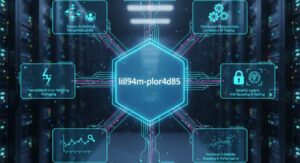
While a user might encounter lill94m-plor4d85 in a log file, a database entry, or a URL parameter, its presence signals the operation of a sophisticated tracking or labeling system. These codes act as the “connective tissue” of the internet, allowing disparate systems—ranging from edge devices in the Internet of Things (IoT) to massive data centers—to communicate with surgical precision. This article examines the technological underpinnings of such identifiers, analyzing how they are generated, how they enhance system security, and why their role in 2025 is more critical than ever for the stability of our global digital infrastructure.
The Anatomy of High-Entropy Alphanumeric Strings
The construction of modern system identifiers is a deliberate process involving mathematical algorithms designed to maximize uniqueness while minimizing the length of the string. Typically, these strings are divided into segments that serve specific functions. The first portion often acts as a shard or a prefix, indicating the origin of the data or the specific cluster where the information resides. The latter half usually contains the entropy—a randomized set of characters that ensures the identifier is unique even among billions of other entries. By combining fixed architectural markers with randomized payloads, developers create a naming convention that is both informative for the system and secure against predictability.
In many cases, these identifiers utilize Base64 or hexadecimal encoding to represent binary data in a text-based format that is safe for transmission over web protocols. This prevents issues like character encoding errors when data moves between different programming languages or operating systems. The use of a hyphenated structure also aids in human legibility during debugging sessions without compromising the machine’s ability to parse the code rapidly. This structural balance is what allows a complex identifier to serve as a reliable anchor for data integrity in environments where speed and accuracy are non-negotiable.
Integration Within Distributed Microservices Environments
In the current era of software development, monolithic applications have largely given way to microservices architecture. In this model, a single user request might trigger hundreds of small, independent services to work together. To ensure that the request remains coherent as it bounces through the network, a correlation ID is assigned. This is where identifiers like lill94m-plor4d85 play a vital role. They act as a digital thread, tying together every log entry, database query, and API call associated with a specific event. Without these unique markers, it would be virtually impossible for engineers to reconstruct the path of a request or identify where a failure occurred in a complex web of services.
The implementation of these IDs is often handled by specialized middleware or service meshes. These tools automatically inject the identifier into the headers of every outgoing message. When the receiving service processes the message, it extracts the ID and includes it in its own logs before passing it to the next service. This create a verifiable audit trail that spans the entire infrastructure. This level of traceability is not just a convenience; it is a fundamental requirement for maintaining high-availability systems that serve millions of users across different geographical regions simultaneously.
Security Layers and the Prevention of ID Guessing Attacks
From a security perspective, the complexity of an identifier is its greatest strength. Older systems often used simple, incremental integers for record-keeping. However, this allowed malicious actors to perform “Insecure Direct Object Reference” (IDOR) attacks, where they would simply increment the ID number in a URL to access data belonging to other users. Modern identifiers solve this problem through high entropy. Because a string like lill94m-plor4d85 is selected from a pool of trillions of possible combinations, it is computationally impossible for an attacker to “guess” a valid ID.
This “security through obscurity” is further enhanced by the use of cryptographic hashing. Some systems do not just generate a random ID; they derive it from a combination of the user’s session data and a secret server-side key. This ensures that even if an ID is exposed, it cannot be easily replicated or forged. In 2025, security protocols often require these identifiers to be rotated frequently, adding another layer of defense. By ensuring that an ID is both complex and temporary, organizations can protect sensitive data flows and ensure that only authorized entities can access specific resources within the cloud environment.
Impact on Global Database Scalability and Performance
When dealing with “Big Data,” the choice of an identifier has a direct impact on database performance. Traditional primary keys can cause “hotspots” in a database cluster if they are inserted sequentially, as all new data might hit the same physical shard. High-entropy identifiers distribute the write load more evenly across the entire cluster because their randomized nature ensures they are spread across the index. This allows for massive horizontal scaling, where thousands of database nodes can work in parallel without bottlenecking each other.
Furthermore, many modern databases use these identifiers as “clustering keys,” which determine how the data is physically stored on the disk. By optimizing the way these IDs are generated, engineers can ensure that related data points are stored close to one another, reducing the time it takes for the system to read information. This optimization is particularly crucial for real-time applications like financial trading or social media feeds, where a millisecond of latency can have a significant impact on the user experience. The identifier is thus not just a name, but a tool for physical data organization.
Role in IoT Device Management and Edge Computing
The explosion of the Internet of Things has brought billions of new devices online, each requiring a unique identity to communicate securely with the cloud. In these resource-constrained environments, identifiers like lill94m-plor4d85 provide a lightweight yet robust way to manage device lifecycles. Whether it is a smart thermostat, an industrial sensor, or an autonomous vehicle, the device must be able to prove its identity before it is allowed to transmit data. This is often handled through a “Device Twin” system, where a digital representation of the hardware is maintained in the cloud, indexed by its unique identifier.
At the “Edge”—where data is processed closer to the source rather than in a central data center—these IDs allow for localized decision-making. For example, a smart factory might have thousands of sensors reporting to a local gateway. The gateway uses the unique IDs to determine which sensor is reporting an error and can trigger a localized shutdown without waiting for instructions from a remote server. This localized intelligence relies entirely on the precision of the identification system, ensuring that every command is addressed to the correct piece of hardware with zero ambiguity.
Traceability and Error Handling in Software Development
One of the most practical uses for a unique system marker is in the realm of debugging and error reporting. When a software application crashes, it often generates an “Error Reference ID.” If a user reports this ID to a support team, the engineers can use it to pull up the exact “stack trace” or snapshot of the system state at the moment of the failure. The lill94m-plor4d85 code serves as a unique key that unlocks the specific diagnostic data needed to solve a problem. This drastically reduces the “Mean Time to Recovery” (MTTR), which is a key metric for software reliability.
In 2025, many systems have moved toward “Observability,” which goes beyond simple monitoring. Observability platforms use these identifiers to create “Spans” and “Traces.” A span represents a single operation, while a trace is the collection of spans that make up a full transaction. By visualizing these traces, developers can see exactly where a bottleneck is occurring—perhaps a specific database query is taking too long, or a third-party API is failing. This granular visibility is only possible because every component of the system agrees on the unique identifier for the transaction in progress.
Future Evolution of Decentralized and Smart Identifiers
As we look beyond 2025, the way we generate and manage identifiers is likely to shift toward decentralized models. Technologies like blockchain and Distributed Ledger Technology (DLT) offer a way to create “Self-Sovereign Identities” (SSIs). In this model, an identifier like lill94m-plor4d85 could be owned by the user or the device itself, rather than being issued by a central authority or a single corporation. This would allow for greater privacy and interoperability, as the same identifier could be used across different platforms without the need for multiple accounts.
Furthermore, we are seeing the emergence of “Smart Identifiers” that contain embedded logic. Using artificial intelligence at the infrastructure level, these IDs could potentially route themselves through a network based on the priority of the data they carry. For example, an ID associated with an emergency medical alert would be prioritized by the network over an ID associated with a routine software update. This evolution represents the next step in the “Programmable Internet,” where the metadata surrounding our data becomes as intelligent and dynamic as the data itself.
Technical Comparison of Identifier Types
| Identifier Category | Examples | Typical Length | Collision Risk | Primary Use Case |
| Numeric ID | 482910 | 1 – 10 Digits | High | Small local databases |
| UUID (v4) | f47ac10b-58cc-4372-a567-0e02b2c3d479 | 36 Characters | Extremely Low | Distributed web systems |
| Composite ID | lill94m-plor4d85 | 10 – 20 Characters | Very Low | Specialized system tracking |
| Object ID | 507f1f77bcf86cd799439011 | 24 Characters | Low | Document-based databases |
Frequently Asked Questions (FAQs)
What exactly is the lill94m-plor4d85 identifier used for?
In the context of modern computing, this string is likely used as a Unique Identifier (UID) within an internal system. It serves to label a specific resource—such as a user session, a hardware component, or a transactional record—to ensure that it can be tracked and managed without confusion across a distributed network.
Is it safe to see codes like lill94m-plor4d85 in my browser or logs?
Yes, it is perfectly safe. These codes are part of the “plumbing” of the internet. They are intended for use by computers to organize data. Seeing such a code usually just means that the system is functioning correctly and is able to track its internal processes with precision.
How are these identifiers generated?
Most are generated using Pseudo-Random Number Generators (PRNGs) or cryptographic algorithms. These algorithms ensure that the resulting string has high entropy, meaning it is unique and cannot be easily predicted by a human or a malicious program.
Why do some systems use hyphens in their identifiers?
Hyphens are used to improve human readability and to separate logical segments of the ID. For example, the first part might represent a data shard, while the second part is the unique random string. It makes it easier for engineers to scan log files during maintenance.
Can a duplicate identifier ever be created?
While mathematically possible, the probability is so low that it is considered a “statistical impossibility.” For high-entropy strings, the chance of a collision (two identical IDs) is roughly equivalent to the chance of an asteroid hitting a specific house on a specific day.
Conclusion
The identifier lill94m-plor4d85 is more than just a sequence of characters; it is a fundamental building block of the modern digital experience. As systems grow in complexity and scale, the need for precise, secure, and performant identification becomes increasingly paramount. From facilitating communication between microservices to securing IoT devices and enabling global database scalability, these strings ensure that our digital world remains organized and reliable. While they often operate in the background, invisible to the average user, their contribution to system stability and data integrity is immense. As we move into the future of decentralized and AI-driven networks, the evolution of these identifiers will continue to play a central role in how we build, secure, and navigate the vast digital frontier.

